
I Am a “Bibim Ingan:” On Having a Corrective Emotional Experience While Watching Culinary Class Wars
Yes, Chef! We Are Mixed Up Humans
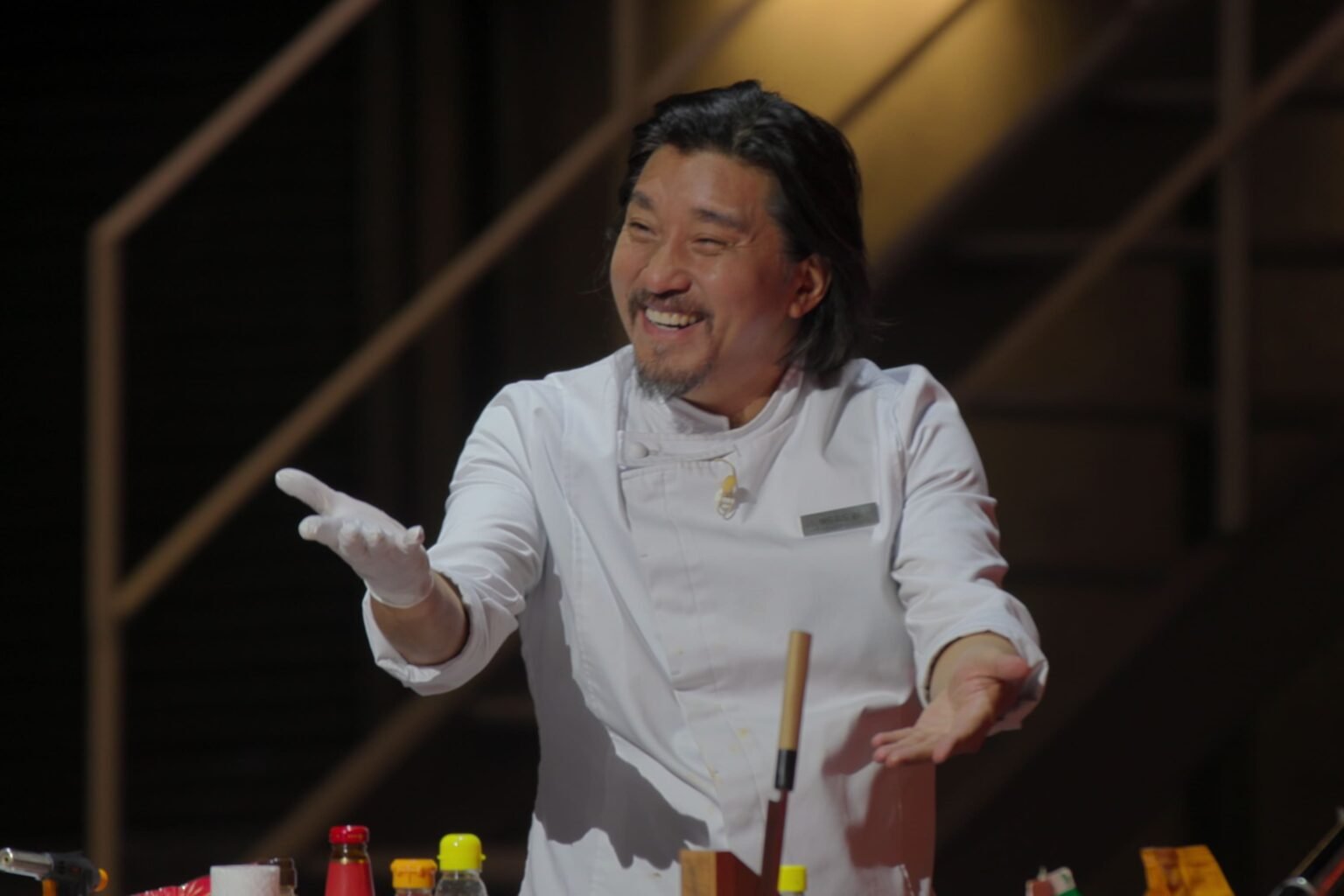
When Chef Edward Lee pulled out a piece of paper and, in a tremulous voice, said "저는 비빔 인간입니다," my eyes were wet and I felt my chest heaving. I let out a sigh of relief, as if I had been waiting my whole life for someone to utter such inane and yet moving words on TV. Therapists call this a corrective emotional experience. It’s when something happens that rewrites, even slightly, what you believed was true. I didn't expect to find mine on a Korean cooking competition show.
I'm a younger Gen Xer, born in 1980, and I grew up very rarely seeing anyone who looked like me on TV. There was Connie Chung, of course. There was Margaret Cho, who is now appropriately regarded as a national treasure. And not much else. Now, as a Korean American woman at mid-life, I find myself watching Korean TV almost exclusively, often from the lens of a sort of/kind of outsider, but thoroughly absorbed nonetheless. I'm in awe when Korean Americans are part of a Korean variety show or K-drama. It’s a little message that says, “This Korean universe has room for all of us.”
In Season 1 of Culinary Class Wars, Chef Edward Lee, a much-acclaimed chef in the US, not only throws down with the most interesting and technically skilled dishes, he also talks about his relationship with Koreanness in broken Korean and English. Another memorable soundbyte from the show was when he said, "Deep down, I am a Korean person." It's such a simple statement for such a complicated sentiment. I read it as: Despite always having to choose not to be, I am a Korean person. Or: Though it has caused me much confusion and pain, I am a Korean person. Or: After a lifetime of American culture suggesting that I must not be, I am indeed a Korean person. In his beautiful declaration, he captures something ineffable.
A bibim human translates to "mixed up human." It’s a new term coined by Lee. They’re two words that have never been put together like this before. It's poetic in its conciseness — the bibim in bibimbap, that dish of rice and vegetables and gochujang that began as something made from leftovers and became a celebrated global export. As a metaphor, it's beautiful. Everything gets mixed together. Korean Americans are an amalgamation of all the things we absorb: Korea itself, the specific region our families came from, the frozen-in-time diasporic version of Korean culture we inherit at home. The part of the US we grow up in shapes us too. California Korean Americans are different from those who grew up in Arkansas, just as New Jersey Korean Americans are different from those who grew up in the suburbs of Texas. There's the religion piece, the spectrum of how strict your parents were, the intergenerational weight of it all. The friends you made in childhood. The music. The snacks. And if you're older like me, the memory of the whole family gathered around the TV for the 1988 Olympics in Seoul, hearts swelling with both anxiety and pride. The diaspora also includes a wide variety of hapas, each with their own bibim experience, their own particular flavor of in-between.
To be a bibim human is not a tidy thing. It is not a resolution or an arrival. It is, perhaps, an ongoing negotiation with the culture you came from, the culture that shaped you, and the version of yourself that exists somewhere in the overlap. What moved me about Chef Edward Lee was not just the sentiment but the courage of saying it out loud, on camera, in juvenile and imperfect Korean, on Korean television. The acknowledgment that you can be mixed up and still be whole. That the leftovers can become something worth celebrating, even if the dish is still, always, a little different every time you make it.