
The 8 Different Types of Self-Care
Is Self-Care What You Think It Is?
In a recent meeting with colleagues, the idea of self-care came up. It’s a word that used to help me justify getting my nails done as often as possible. And now, I’m not sure what it means anymore. I’m finding that it means something different to just about everyone I know. Maybe that’s the way it should be. We are not all the same, so why would we all want or need to do meditation and knitting? In order to think more expansively about self-care, this Ted talk by Portia Jackson-Preston is a great starting point. She points out that the self-care needs of BIPOC and other marginalized communities can be different. The self-care activities can be different and the self-care may be a nourishing response to triggers that are related to one’s identity or marginalized status. Her talk invites us to be intentional and specific, which I find really helpful. For instance, if I am feeling triggered because of a racial micro-aggression, my self-care in response to that may not be to go to my local yoga class that is comprised of mostly white people. Instead, I might talk to my Asian friend who can support me while I vent about it, or I can practice qi gong at home to feel a bit more grounded.
One of my colleagues shared the image below to help us think about different types of self-care. I found this really helpful because we often talk about self-care as one thing that is supposed to help us feel better but actually, it’s a whole system of intentional strategies that protect our energy and well-being. And it’s not confined to just what we do at home. Nearly every realm of life provides opportunities for supporting ourselves a bit better.
The 8 different types of self-care are physical, emotional, social, spiritual, personal, space, financial, and work. Looking at this graphic, what can you give yourself credit for already doing? What would you genuinely like to do more of? Or, what would be beneficial but also seems reasonably easy to do? There’s so much fodder here for therapy too. For instance, what boundaries would help to support your peace of mind?
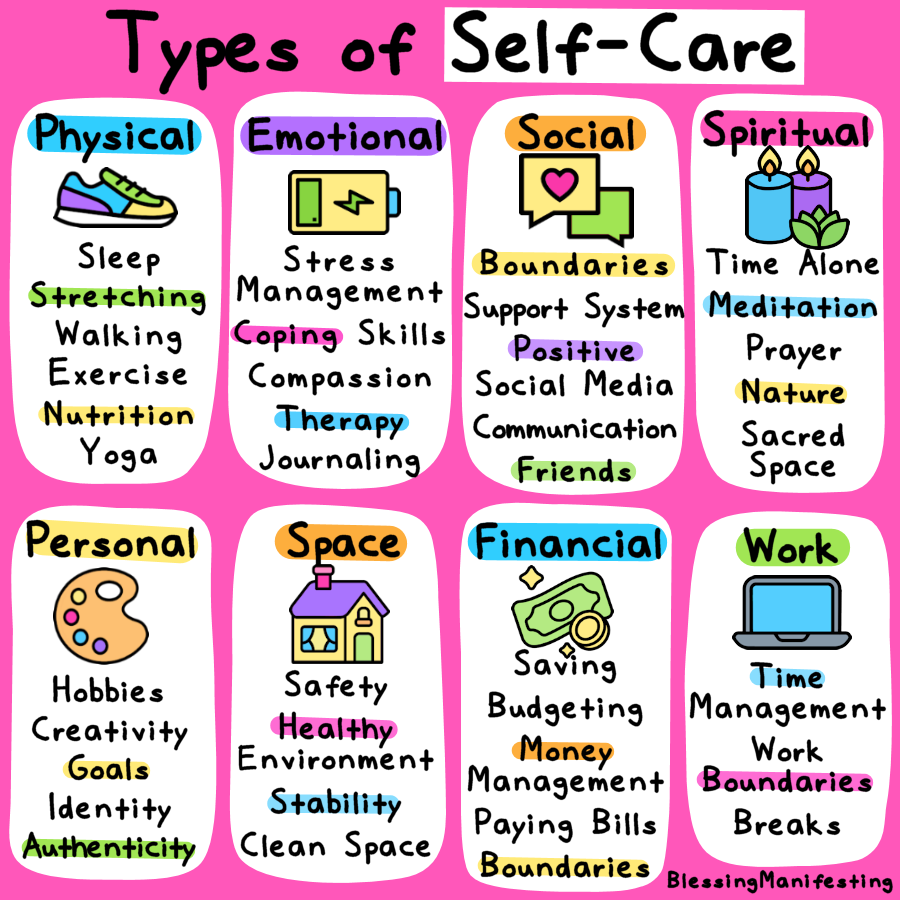
Image source: Carlisle Healthcare, UK.
What We Have Control Over
One of the hardest things to accept about life is that we don’t have control over all the things we want to have control over. We can’t control other people. We can’t control (usually) what happens at our jobs. We don’t always have control over our physical and medical health. What we do have control over is a lot of the stuff in the graphic above, such as how we cope, how much time we allow ourselves to be alone, how we engage with creativity, etc. Sometimes well-being just boils down to taking control of the things you can take control of, rather than dwelling on the things that are outside of your control. That’s why self-care is so empowering when we finally decide to make it a priority.